
Volume 5 Issue 2
By Jessica Barker-Wren, University College London
Citation
Barker-Wren, J. 2026. BIG FISH, BIG TIME: Exploring more-than-human temporal affect with respect to sturgeon. Routes, 5(2): 21-32.
1. Introduction
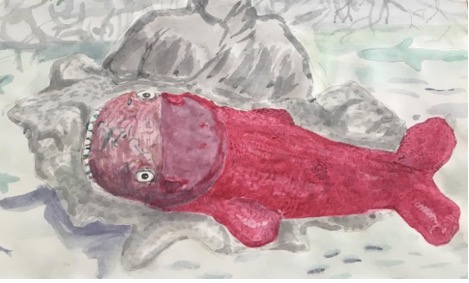
Fig. 1 A ‘fish’ I once dreamt of. Painting by author.
From time to time, I dream of fish, uncanny, compelling, and not always a species I recognise. In one such dream an ancient hulk of a fish chased me down the stairs in a rage, insisting we were related. On waking, I drew the creature, and identified it as a sturgeon, prompting a sustained curiosity about these ancient beings and how I might relate to them. Sturgeon are extraordinary fish: emerging in their current guise during the upper Cretaceous about 100 million years ago, adults’ huge bodies are armoured with bony scutes and powerful fins that propel inexplicable vertical leaps out of the water– I hasten to add that they cannot run downstairs. Sturgeon can live to 120 years, with females reaching breeding maturity between 15-25 years old (Hilton et al., 2016)—enough time for seven generations of sturgeon persons. As I will go on to discuss below, seven generations is the temporal frame of responsibility and relation for the Anishaabeg people who successfully restored them (Acipenser fulvescens) in the Great Lakes. Although currently extinct in the UK, over the last decade there have been several sightings of sturgeon (Acipenser sturio) off our coast (ZSL 2023), and the Blue Marine Foundation hopes to encourage these sturgeon into the Severn River catchment. Should we succeed in welcoming sturgeon into UK waters, I ask, how might sturgeon’s longevity articulate with our temporal affective logics of time?
In what follows, I adopt a Deleuzian concept of affect as “intensities”, and explore the affective potential of reintroducing sturgeon to the UK with respect to temporality; suggesting how their return might prompt a readjustment of temporal context—that is, the temporal window we consider as relevant to ourselves on a day-to-day basis in decision making and figuring our own futurities. Building on Kathleen Stewart’s (2007) scholarship, temporal affect here is an intensity both in “broad circulation” (ibid, 2) –as with working weeks or particular calendrics– and equally a quality that constitutes the intimate– such as the span of time shared with loved ones. I use Laura Bear’s (2016) framing of time as a “technology of imagination” to explore commodification and truncation of lifespans which profoundly diminish more-than-human sociality (Tsing, 2013) producing as Jane Guyer (2007) describes an “evacuated near future”. I contrast these temporal frameworks with the Anishinaabeg approach to temporal affect in their successful Great Lakes sturgeon restoration. I contend that where attention spans are short, and we increasingly abandon our human elders to a “time-scarce” care-economy, foregrounding longevity and intergenerational care for the more-than-human, as the Anishinaabeg have done, is a radical act. Bringing sturgeon and people back to the river might thereby encourage us to adopt much needed alternative technologies of imagination.
2. Market temporalities and the evacuated near future
In Time as Technique, Laura Bear (2016) frames affective logics of time as an heuristic assembled as “technologies of imagination” (ibid, 489) to act on the social and more-than-human alike. Similarly, in addressing temporality, Jane Guyer (2007) draws a parallel between temporal rhetorics of evangelical Christianity and free market orthodoxy, both of which direct our attention to the immediate moment and the distant future, leaving an “evacuated near future” (ibid) of stochastic dates. In Christian evangelical temporalities, the distant past is storied in detail to give context to the present. In the present, believers are counselled to wait and endure in “the gap”– the duration of which is indeterminate – in a distant future waiting will be relieved in the second coming of a messiah. Guyer notes that the dictums of the market extolled by Friedrich Hayek in The Road to Serfdom (1944) parallel these rhetorics of the evangelical church. Although the Free Market is a newcomer in the world’s longue durée, its affective temporal logic continues to shape human imaginaries[1] of the future, environment and non-human lives (Fisher, 2009; Moore, 2015; Mathews and Barnes, 2016).
This temporal logic finds a clear expression in the recent marketisation of biodiversity in the UK through “Biodiversity Net Gain” (BNG) policies, which adopt a similar temporal affective valence (Massumi, 2015), producing an evacuated near future. The “market” is prioritised in the present, and the promise (but by no means the guarantee) of biodiversity in the distant future is exchanged under the auspice of sustainable growth, in a manner which ignores the continuity and specificity of on-going-ness. Here, notwithstanding the liveliness of all matter acknowledged in Anthropology’s “quantum turn” (see Barad, 2007), I follow Eduardo Kohn (n.d) and Anna Tsing (2013) in distinguishing vital entities from the material for their tendency to “include futures in what they do in the present” (ibid, 28). I do not make this distinction in-order to privilege either the vital or material, only to indicate that whilst the material can “wait” to a degree—for example without oxygen—the vital cannot.
BNG erroneously construes the quality of biodiversity as “providable”, as alienable and exchangeable, rather than spatially and socially specific, and importantly for my purposes, temporally contingent. UK developers can build in the present on areas labelled as “biodiverse” so long as they commit to “provide” a 10% net gain of biodiversity elsewhere in the future, whether or not said biodiversity really can be reconstituted. Rewilding, could easily become enrolled in these projects, we should therefore ask “which wild?”. We know that vanishingly rare chalk stream ecologies are entirely contingent upon their bedrock formed by the passage of geological time, oak forests require centuries; that is to say nothing of the more-than-human socialities fractured in century old rook colonies, for example. What becomes then, of those living kinds that cannot “endure the gap” when their homes are built upon? These “tissues of on-going-ness” (van Dooren, 2014) require both physical and temporal continuity that is not addressed in BNG policy. In the case of European sturgeon in British rivers, “waiting” for the restoration of free rivers precipitated local extinction, which seems to have gone largely unremarked upon.
Yet there are representations of sturgeon which allow us to trace their historic
importance. Their coiled form appears on the lamp posts of Balzelgette’s Thames
embankment and at Lepenski Vir on the banks of the Danube, where turbulent rapids make the ideal spawning ground (Bartosiewicz, Sisu, and Bonsall, 2008). This Mesolithic settlement features stone monuments, all facing the river, which resemble various states of metamorphosis between human and sturgeon with downturned mouths and bony scutes, gesturing to the importance of sturgeon for its inhabitants (Živaljević, 2012; Boric, 2005) who recorded their likeness in stone (see fig. 2). How then did we cease to care about sturgeon’s absence?
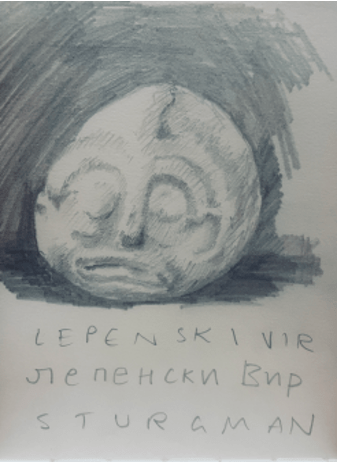
Fig. 2 ‘Danubijus’ carving Lepenski Vir. Sketch by author.
More-than-human charisma is reticulate (Thrift, 2005) and emergent, determined by very particular affective logics. In the affective logics of intensive farming ecologies, lifespan is subordinate to profit (Lorimer, 2015) and market time. Chickens’ potential lifespan runs for 8-15 years, yet in industrial farms laying hens typically live 20 months and male chicks a matter of minutes. The same truncated lifespans now imperil the Severn Estuary, where metabolised phosphorous used as feed in intensive poultry farming in the Wye (Barua, 2018) compromise proposed sturgeon habitat, demonstrating the broader impacts of the temporality demanded by market logics.
3. Seven generations: Alternative temporal frameworks
The successful restoration of Great Lakes sturgeon (Acipenser Fulvescens)—N’me in Anishinaabemowin—offers a fundamentally different temporal approach. These restorations have been led and funded by First Nation groups who have retained relation to their sturgeon (Holtgren, 2013). As N’Me to the Anishinaabeg First Nation, sturgeon are ancestors to humans and fish alike, bearing the knowledge and souls of the Sturgeon Clan (Mitchell, 2013; Langston, 2021). In the Anishinaabeg lifeway, humans are responsible for ensuring the on-going-ness of seven generations— this is their temporal frame, and they have restored sturgeon to their rivers accordingly. Indigenous knowledge is held in embodied, current (Borrows 2016) and site-specific ways (Todd, 2014) often transmitted within story form. As a white British scholar participating in a system of academia which so often excludes indigenous narratives, and persists in a colonial occupation and legislation of Turtle Island ( the territory now referred to as North America by settlers), whilst acknowledging the on-going-ness of this violence and struggle, my aim here is to offer a reflection on what we can learn from Anishinaabeg sturgeon worlding as a profoundly different approach to pervasive notions of truncated, anthropocentric “market time” (Bear, 2016), without suggesting we can “become indigenous” (Reid and Chandler, 2020).
The aim of Lawrence River Anishinaabeg management was “bringing people and sturgeon back to the river” (LRBOI, 2008, in Holtgren, 2013). This aim places more-than-human kinship as central to the restoration (Mitchell, 2013; Holtgren, 2013). Jimmie Mitchell of the Anishinaabeg N’me (2013) notes that Anishinaabeg ensure that benefits now enjoyed, endure for seven generations to come. This is an affective temporality that differs from technologies of imagination which act upon the non-human. Instead, this temporality is embedded and inseparable. For the Anishinaabeg and Menominee N’me clans, sturgeon are grandfathers and grandmothers (Langston, 2021), they are already kin and carry the souls of the dead and the clan knowledge; each group of sturgeon is specific to a spawning site, and have social groups of their own.
These clan teachings were vindicated when century-old individual sturgeon with the knowledge of spawning sites led the return to spawn after dam removals (Interview with Dave Grignon, in Schmitt Kline, 2007). Here successful restoration may have hinged on one or two individual sturgeon without which restoration might even have failed. Furthermore, ecologists Pierre Dumont and Yves Mailhot (2013) note that “on at least three occasions pairs of fish that were tagged simultaneously, were recaptured together” (Dumont et al., 1987 in ibid, 110) supporting the idea of sociality amongst the long-lived fish.
Recent scholarship on sociality and longevity of fish indicates that, much like humans, fish depend on older individuals and sociality to learn migratory routes and feeding grounds in difficult seasons (Wilson, Giske, and Brown, 2025). Human fishing effort tends to target either whole shoals or large individuals, and when deployed en masse by mega-trawlers, this creates chaos amidst fish populations, since knowledge is borne by large individuals and disseminated in groups (Wilson 2017; Wilson, Giske and Brown 2025). The Anishinaabeg seem to have come to this knowledge another way. They are among several First Nation groups to venerate the age, knowledge and more-than-human sociality of sturgeon. It would not be the first instance of complementarity between Indigenous and Settler Scientific knowledges (Kimmerer, 2013; Black Elk, 2016; Daly and Shephard, 2023).
4. Implications for UK sturgeon restoration
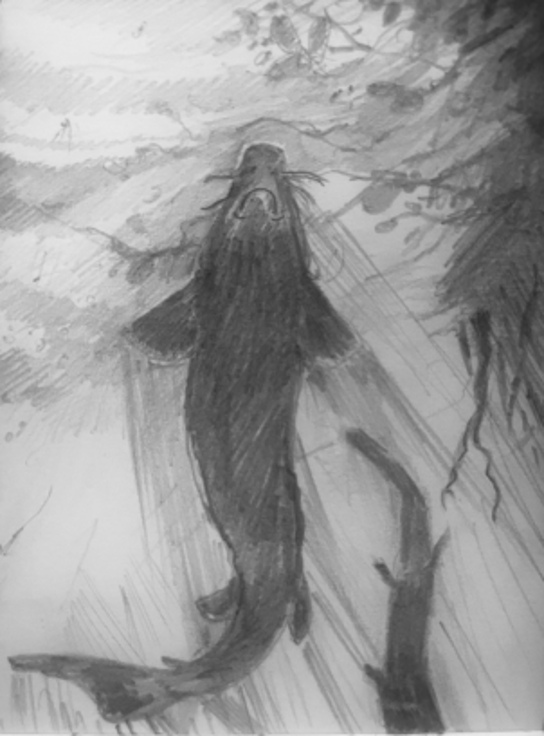
Fig. 3 Sturgeon from the perspective of river gravel. Sketch by author
What would it require then to allow sturgeon to live out the fullness of their 120-year span in the Severn? Re-establishing sturgeon would take considerable time and patience, both of which are free, though often constructed as scarce by capitalist
technologies of imagination (Smith, 1982). Sturgeon need turbid rapids on gravel, and cool waters shaded by forests to spawn. Ironically, once the deforestation of European settlers in North America became truly desperate, sturgeon bodies were stacked up like logs and burnt as fuel in steamboats to portage timber down the river (Langston, 2021; Mitchell, 2013). Ancient fish and forests walk hand-in-hand, or should I say fin-by-root?
However, I wish to consider a more recalcitrant temporal dimension as it relates to sturgeon, not only with regard to repeated encounter, but also duration and thereby a renewal of relation as kinship with sturgeon individuals over generations. In “Underflows”, Cleo Wolf Hazard (2022) extends Elizabeth Freeman’s (2007) definition of queer kin to the more-than-human. These more than-human affinities are evident in the knowledge many colonised nations (Willey, 2016). Working within the academy Freeman constructs kinship as embodied and temporal, following Judith Butler (1993) to construe kin as the act of mobilising the resources of one body for another as embodied care and vulnerability, that is renewed over one’s lifetime, and enacts the desire to belong to spatial and temporal structures beyond the present, to “offer oneself beyond one’s own time” (Freeman, 2007, 299). Making kin with slow growing, long-lived sturgeon might thereby counter dominant strains of relation that reduces the more-than-human to lively capital (Rajan, 2006) with concomitant ecological consequences.
The Anishinaabeg made a successful restoration of their sturgeon in part by acknowledging the many contingent relations that enmesh to foster the sturgeon lifeway, the relation of river and rocks, of light and trees. Their cosmology makes sturgeon kin, their ethics of time (Rose, 2012) is inclusive of non-human, enrolling seven generations of humans to see the N’me through a lifetime.
5. Recalibrating temporal affect
Foregrounding relations with sturgeon as one of potential kinship in the UK invites a recalibration of temporal affect. Their longevity unsettles the accelerated and extractive logics of the market where time lived without guaranteed productivity becomes a radical act. As young re-wilders, we have the opportunity to re-instate a “technology of imagination” that cares, radically, for the living, and acknowledges these relations by giving something of ourselves to the future and recognising the urgency of embodied care in the present. This does not take much, it takes raising our eyes from screens, mobilising our bodies and checking in with the planetary temporality– that is the rise and fall of the sun, the breath of seasons–going renewing bonds through care. This could be cooking with an elder, dancing with our chosen family, seeking out our local river and checking to see how it is doing. As young rewilders, this is an embodied practice of time and care that we can reclaim for each other, for free.
References
Barad, K. (2007). Meeting the Universe Halfway: Quantum Physics and the Entanglement of Matter and Meaning. Durham: Duke University Press.
Barua, M. (2018). Animal Work: Metabolic, Ecological, Affective. Theorizing the Contemporary, Fieldsights, July 26.
Bartosiewicz, L, Sisu, V and Bonsall, C. (2008). Sturgeon Fishing along The Middle and Low Danube in The Iron Gates in Prehistory: New Perspectives. Edited by Clive Bonsall, Vasile Boroneanț, and Ivana Radovanović. BAR International Series 1893. Oxford: Archaeopress. Bear, L. (2016). Time as Technique. Annual Review of Anthropology, Vol. 45, pp. 487-502.
Black Elk, L. (2016). Native science: Understanding and respecting other ways of thinking. Rangelands, 38(1), 3–4.
Boric, D. (2005). Body Metamorphosis and Animality: Volatile Bodies and Boulder Artworks from Lepenski Vir. Cambridge Archaeological Journal 15 (1): 35–69.
Borrows, J (2016) Freedom and Indigenous Constitutionalism. Toronto: University of Toronto Press.
Butler, J. (1993) Bodies that Matter: On the Discursive Limits of “Sex”. New York: Routledge: 1–23
van Dooren, T. (2014). Flight Ways: Life and Loss at the Edge of Extinction. Columbia University Press.
Dumont, Pierre and Mailhot, Yves. (2013). The St. Lawrence River Lake Sturgeon: Management in Quebec, 1940s–2000s.in The Great Lake Sturgeon, edited by Nancy Auer and Dave Dempsey, 101–32. Michigan State University Press.
Fisher, M. (2022). Capitalist Realism: Is There No Alternative? Second edition. Alresford, Hampshire, UK: Zero Books.
Freeman, E. 2007. Queer Belongings: Kinship Theory and Queer Theory. In A Companion to Lesbian, Gay, Bisexual, Transgender, and Queer Studies, edited by George E. Haggerty and Molly McGarry, 1st ed., 293–314. Wiley.
Guyer, J I. (2007). Prophecy and the near Future: Thoughts on Macroeconomic, Evangelical, and Punctuated Time. American Ethnologist 34 (3): 409–21.
Hayek, F. A. (1944). The Road to Serfdom. University of Chicago Press
Hazard, C, W. (2022). Underflows: Queer Trans Ecologies and River Justice. Feminist Technosciences / Rebecca Herzig and Banu Subramaniam, Series Editors. Seattle: University of Washington Press.
Hilton, E. J., Kynard, B., Balazik, M. T., Horodysky, A. Z. and Dillman C. B. (2016). Review of the Biology, Fisheries, and Conservation Status of the Atlantic Sturgeon, (Acipenser Oxyrinchus Oxyrinchus Mitchill, 1815). Journal of Applied Ichthyology 32 (S1): 30–66.
Holtgren, M. (2013). Bringing Us Back to The River. In The Great Lake Sturgeon, edited by Nancy Auer and Dave Dempsey, 133–46. Michigan State University Press.
Ingold, T. (2013). Anthropology Beyond Humanity. Suomen antropologi. 38(3):5-23 Interview with Dave Grignon, (2007) Interviewer Kathleen Schmitt Kline, People of The Sturgeon. Mp3. University of Wisconsin-Madison Oral History Program.
https://ohms.library.wisc.edu/viewer.php?cachefile=Grignon_D_20070110.xml. Kimmerer, R. W. (2015). Braiding sweetgrass. Milkweed Editions.
Kohn, E. (2013). How forests think: Toward an anthropology beyond the human. Berkeley, CA: University of California Press.
Langston, N. (2021). Climate Ghosts: Migratory Species in the Anthropocene. Brandeis University Lorimer J (2015) Wildlife in the Anthropocene: Conservation after Nature. Minneapolis, MN: University of Minnesota Press
Massumi, Brian. (2015) Politics of Affect / Brian Massumi. Cambridge, UK ; Polity. Mathews, A and Barnes, J. (2016) Prognosis: Visions of Environmental Futures. Journal of the Royal Anthropological Institute (N.S.), 9-26. Wiley.
Mitchell, J. (2013) ‘N’me’. In The Great Lake Sturgeon, edited by Nancy Auer and Dave Dempsey, 21–26. Michigan State University Press.
Moore, J W. (2015) Capitalism in the Web of Life: Ecology and the Accumulation of Capital. London: Verso.
Rajan, KS. (2006) Biocapital: The constitution of postgenomic life. Duke University Press Durham and London.
Reid, J., & Chandler, D. (2019). Becoming Indigenous: Governing Imaginaries in the Anthropocene. Rowman & Littlefield publishers
Rose, D, B. (2012) Multispecies Knots of Ethical Time. Environmental Philosophy, 9(1), 127–140. Shephard, G and Daly, L. (2023) Sensory Ecology, Bioeconomy, and the Age of COVID: A Parallax View of Indigenous and Scientific Knowledge, Topics in Cognitive Science. 15(3). 584-607
Smith, M F. (1982). Bloody Time and Bloody Scarcity: Capitalism, Authority, and the Transformation of Temporal Experience in a Papua New Guinea Village. American Ethnologist 9 (3): 503–18.
Stewart, K. (2007). Ordinary Affects. In Ordinary Affects (pp. 1–130). Duke University Press. Thrift, N. (2005) But malice aforethought: cities and the natural history of hatred. Transactions of the Institute of British Geographers, 30(2), 133-150.
TallBear, K.,Willey, A. (2019) Introduction: Critical Relationality: Queer, Indigenous, and Multispecies Belonging Beyond Settler Sex & Nature. Imaginations, vol. 10, no. 1, pp. 5–15
Todd, Z. (2015) Indigenizing the Anthropocene H. Davis, E. Turpin (Eds.), Art in the Anthropocene: Encounters Among Aesthetics, Politics, Environments and Epistemologies, Open Humanities Press, pp. 241-254
Tsing, A. (2013). More-than-human sociality: a call for critical description. In K. Hastrup (Ed.), Anthropology and Nature (pp. 27-42). Routledge.
Willey, A. (2016) Monogamy’s Nature: Colonial Sexual Science and Its Naturecultural Fruits, Undoing Monogamy: The Politics of Science and the Possibilities of Biology. Duke University Press
Wilson, J. (2017). Learning, Adaptation, and the Complexity of Human and Natural Interactions in the Ocean. Ecology and Society 22 (2): 43–43.
Wilson, J, A., Giske, J. and Brown, C. (2025) Overfishing Social Fish. Fish and Fisheries 26 (2): 278–90.
Živaljević, I. Big Fish Hunting: Interpretation of Stone Clubs from Lepenski Vir Presented at Harmony in Nature and Spirituality in Stone Conference. In Belgrade, March 2012. ZSL UK sturgeon action report 2023. Accessed on14/01/2025.
https://cms.zsl.org/sites/default/files/2023-05/ZSL UK sturgeon action report 2023.pdf.
[1] Humans operating in the dominant global minority Euro-American traditions which is by no means all humans.
#Write for Routes
Are you 6th form or undergraduate geographer?
Do you have work that you are proud of and want to share?
Submit your work to our expert team of peer reviewers who will help you take it to the next level.
Related articles
 Routes