
Volume 5 Issue 1
By Saskia Johnson, University of Cambridge
Citation
Johnson, S. 2026. Just Stop Oil: Impact on Awareness, Perception, and Behaviour Among Students. Routes, 5(1): 80-94.
Abstract
Amidst a failure of UK climate policy, grassroots climate movements like Just Stop Oil (JSO) have gained momentum since 2018. JSO advocates ending fossil fuel use by 2030, employing disruptive tactics to amplify their message. This study examines the influence of JSO on awareness, perceptions, and behaviour among University of Cambridge undergraduates. Data collected via a questionnaire revealed that while JSO’s methods effectively heightened climate awareness, they were largely perceived negatively. However, these sentiments did not translate into polarisation or rejection of JSO’s core demands. Many students reported an increased motivation to engage with climate issues, although fewer expressed interest in actively participating in activism. These findings highlight the complex interplay between protest strategies and their reception among university students, offering insights into how disruptive activism can foster awareness while facing challenges in gaining broader support. This research contributes to the understanding of the impact of activism on young people’s attitudes toward climate advocacy.
1. Introduction
Just Stop Oil (JSO), founded in 2022, is a UK-based environmental activist group campaigning for the UK government to halt new oil and gas licensing. The group employs nonviolent direct action, such as road blockades and the defacing of public monuments, to attract media and public attention to its cause (BBC News, 2023). However, these tactics have faced criticism for appearing to polarise public opinion (Davis, 2022a; Fisher et al., 2023). Nonetheless, protest has long been a cornerstone of Western environmentalism, driving transformative action that the Intergovernmental Panel on Climate Change (IPCC) deems essential to address the climate crisis (IPCC, 2019). Understanding the effectiveness of such movements in influencing awareness, perception, and behaviour is critical to evaluating their impact.
This study seeks to do so, focusing on the student population – a highly engaged and influential demographic in this context (Saunders et al., 2020). Prominent actions by JSO in Cambridge, such as spraying King’s College and organising a slow march through the city in 2023 (Dodd, 2023; Just Stop Oil, 2023), offer a relevant context for exploring the impact of their tactics on University of Cambridge undergraduates.
This study investigates key questions:
- To what extent are Cambridge undergraduates aware of JSO?
- How is JSO perceived among Cambridge undergraduates?
- Which factors influence perception?
- How does the perception of JSO among Cambridge undergraduates influence support for their demands?
- Does JSO influence behaviour among Cambridge undergraduates?
The results and discussion engage both Feinberg et al.,’s (2020) Activist Dilemma and Davis’s (2022) Attention Model to explore their relevance in this context. Feinberg et al. (2020) highlight the tension between moderate actions, which risk being ignored, and extreme tactics, which gain attention but provoke polarisation. Conversely, Davis’s (2022a) Attention Model argues that activism’s primary aim is to capture attention and stimulate discourse rather than achieve popularity, due to its role in awareness and ‘agenda seeding’ (the process by which activism places issues onto the public and political agenda by generating discussion) (Wasow, 2020).
Ultimately, this study aims to determine whether perceptions of JSO are detrimental or helpful to the organisation’s demand to end new oil and gas licenses in the UK (BBC News, 2023). It will situate findings in the context of the student demographic.
2. Methods
This study examines the impact of JSO on students by focusing on University of Cambridge undergraduates. Between 24 June and 24 July 2024, a questionnaire was distributed anonymously through college student committees (see Appendix). This research received ethics approval from the Department of Geography, University of Cambridge.
Given the unique characteristics of the sample population, certain limitations must be acknowledged. The UK climate movement is disproportionately student-driven, with young people frequently at the forefront of activism (Saunders et al., 2020; Hays and O’Neill, 2021). Cambridge students, as part of a highly selective academic institution, are likely to exhibit higher engagement and identification with activism than the public (Feinberg et al., 2020). Therefore, the findings of this study are not representative of the wider population but rather provide insights specific to the student demographic. Nonetheless, the sample provides a valuable opportunity to gain insight from an intellectually engaged, well-informed demographic who can provide a wide range of perspectives from different backgrounds.
It is important to emphasise that the analysis is descriptive. Whilst statistical tests were not conducted due to time and word constraints, the questionnaire results still yielded meaningful patterns. These patterns, when interpreted through Feinberg et al.’s (2020) and Davis’s (2022a) frameworks, offer theoretical insights into activist reception among students.
3. Results and Discussion
The questionnaire elicited 176 responses from a broad demographic profile of University of Cambridge undergraduates. Respondents ranged in age from 18 to 27. The gender distribution was as follows: 50% identified as male, 45% as female, 1% as non-binary, and 4% preferred not to disclose their gender. Participant representation of all subject areas was present, except for ‘History and Modern Languages’ and ‘History of Art’.
3.1. Awareness
Among the respondents, 98% were aware of JSO; awareness referring to having knowledge or attention of the organisation. Of this, 39% were ‘very aware’ and 18% were ‘extremely aware’. The primary sources through which this awareness of JSO is gained are reported in Figure 1. The most prominent source of information through which JSO is encountered is the ‘news’, which consists of 70% of respondents’ sources. Furthermore, of the total respondents, 64% included ‘social media’ in their answers. This reveals a disproportionate number of students gaining their information about JSO through secondary sources – that is, indirect channels such as media coverage, social media, and word of mouth – with 3% of respondents witnessing the actions of JSO in person.
The questionnaire results suggest that JSO’s visibility is largely driven by indirect exposure, which, based on Davis’s (2022a) Attention Model, may indicate that disruptive protest can be successful in securing media attention and seeding public discourse. This is a trait of disruptive protest, which is potentially unachievable through peaceful modes of protest due to the lack of attention they foster (Davis, 2022a; Davis, 2022b).
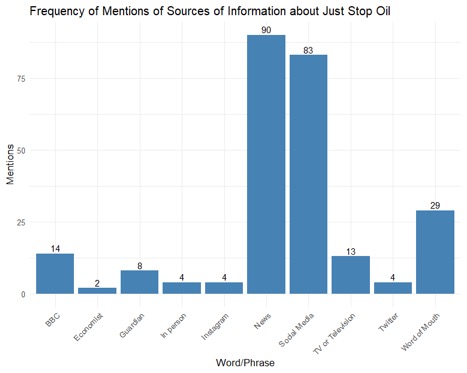
Figure 1. A bar chart showing students’ top ten frequency of mentions of sources of information about JSO.
3.2. Perception
The questionnaire aimed to determine students’ perceptions of JSO, referring to how they are regarded and understood. Figure 2 reveals an overwhelming majority of negative perceptions, which, based on Feinberg et al.’s (2020) Activist Dilemma, suggests a polarising effect resulting from extreme protest tactics. Multiple factors may influence such perceptions.
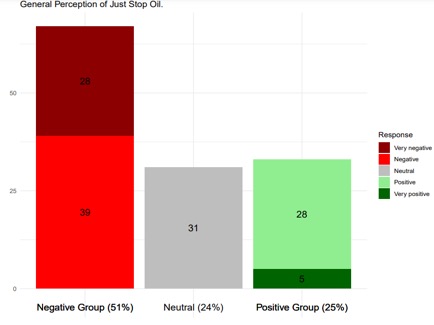
Figure 2. A bar chart illustrating students’ general perceptions of JSO, grouped into ‘negative’, ‘neutral’, and ‘positive’ categories.
3.2.1. Social Identification
The first factor is the role of social identification with the protesters. To test this theory among the population, participants were asked to choose the extent to which they agree with the statement ‘I struggle to connect and identify with the JSO protesters’. Among those with a ‘very negative’ or ‘negative’ perception of JSO, 91% agreed or strongly agreed with this statement. Specifically, 89% of those with a ‘very negative’ view strongly agreed. Conversely, among respondents with a ‘very positive’ or ‘positive’ perception of JSO, only 22% agreed with the statement, while a majority (59%) either strongly disagreed or disagreed.
These findings suggest that, based on Feinberg et al.’s (2020) Activist Dilemma, students who struggle to identify with the protesters tend to view JSO negatively. Furthermore, this suggests that extreme protest tactics reduce identification with activists, thus increasing the risk of polarisation and alienation, even among sympathetic demographics.
3.2.2. Concern for Climate Change
Another factor contributing to an individual’s perception of JSO is one’s preexisting stance on climate change. Figure 3 suggests that those with a lower concern for climate change are more likely to attain a negative perception of JSO. 80% of respondents who were ‘slightly concerned’ or ‘moderately concerned’ about climate change viewed JSO negatively, compared to only 8% who viewed the organisation positively. In contrast, among those ‘very concerned’ or ‘extremely concerned’ about climate change, perceptions were more balanced: 43% negative, 30% positive, and 27% neutral.
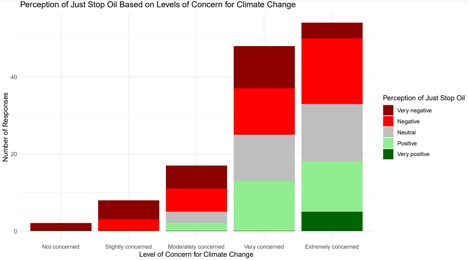
Figure 3. A stacked bar chart showing students’ perception of JSO across various levels of climate change concern.
Further investigation suggests that concern for climate change is linked to levels of justification. Among those who were either ‘extremely’ or ‘very’ concerned about climate change, 40% thought the actions taken by JSO were justified, and 42% disagreed. In contrast, among those with lesser concern (‘slight’ or ‘moderate’ levels of concern), only 17% thought JSO’s actions were justified, and 72% considered them unjustified. This implies that a greater concern for climate change may lead to a higher tolerance of disruptive protest, supporting the idea in Davis’s (2022a) framework that attention-generation outweighs moral discomfort for some individuals.
3.2.3. Nature of the Campaign
The final factor to consider regarding the perception of JSO is the nature of the specific campaign. Notably, the most positively received protest action by JSO was spraying private jets at Stansted airport (with 57.1% perceiving them positively) (Figure 4), providing evidence that campaigns are more likely to garner support from the student population if they are seen as directly addressing the movement’s core issues (Badullovich et al., 2024).
Conversely, according to Feinberg et al.’s (2020) Activists’ Dilemma, actions perceived negatively, such as the blocking of the M25 and the spraying of Stonehenge, are those which are likely to have been seen as immoral, unnecessarily disruptive, or performative due to their unclear logic. These extreme actions are more likely to be perceived as damaging either property or inducing harm to people, leading to a negative perception from the student population. This contrasts with the positively viewed Cambridge march and roadblock, which were likely perceived as peaceful and less harmful to people and property.
These findings suggest that students’ perceptions of protest actions are influenced not only by the actions’ alignment with the movement’s goals but also by their perceived morality and external impact.
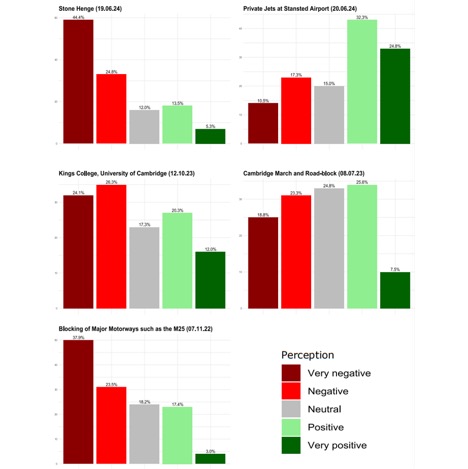
Figure 4. A series of bar charts illustrating students’ perceptions of five different JSO protests.
3.3. Support for JSO’s Demand
To investigate whether the observed perceptions of JSO are detrimental to their cause, the questionnaire examined levels of agreement with JSO’s demand. Among those with a ‘positive’ or ‘very positive’ perception of JSO, none disagreed with the demands; 97% agreed or strongly agreed, and 3% remained neutral. In contrast, among those with a ‘negative’ or ‘very negative’ perception of JSO, 25% disagreed with the demands, while 58% agreed. This suggests that individuals with a negative perception of JSO are more likely to disagree with its demands. However, based on Davis’s (2022a) Attention Model, it may also indicate that negative perceptions do not inherently undermine the movement’s core messaging—support for climate goals can persist despite opposition to specific tactics.
However, the overwhelming majority – 76% – of students agreed with their demands, which include calls for the UK government to end new fossil fuel licences as part of its climate action strategy. Additionally, 84% of respondents either strongly disagreed or disagreed with the statement that ‘the UK government is doing enough to tackle climate change,’ and 60% felt similarly about the University of Cambridge’s efforts. Thus, while a significant portion of students hold a negative perception of JSO, this does not translate into a rejection of its goals.
3.4. Behaviour
Finally, the questionnaire addressed whether JSO’s actions prompted changes in behaviour. Students were asked about their willingness to partake in various actions as a result of their campaigns, as shown in Figure 5. Evidence indicates a notable influence on willingness to change behaviour regarding climate change. 57% of respondents said they were either ‘likely’ or ‘very likely’ to talk to their friends and family about climate change because of the JSO campaigns. 60% of respondents said they were either ‘likely’ or ‘very likely’ to educate themselves about the climate crisis as a result of the JSO campaigns. However, interest in direct participation in climate activism is less pronounced, with 49% claiming they are not likely to take part, with 24% of this being ‘very unlikely’. While students were less likely to join JSO, many reported increased engagement with climate issues. This may suggest, in line with Davis’s (2022a) model, that protest can provoke reflection and engagement even without fostering identification with the activists themselves.
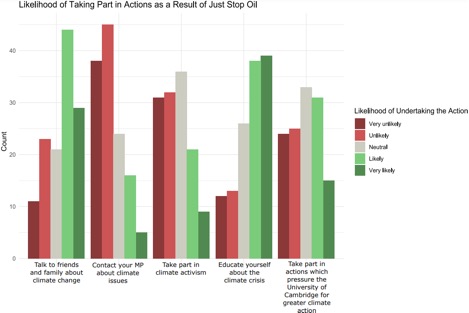
Figure 5. A clustered column chart showing students’ likelihood of undertaking actions resulting from JSO campaigns.
4. Conclusion
This study explored the influence of JSO on Cambridge undergraduate students. The questionnaire results suggest that JSO’s disruptive protest generates substantial visibility and stimulates engagement with climate issues, which, based on Davis’s Attention Model, may indicate that its success lies not in popularity but in agenda seeding (Wasow, 2020; Davis, 2022a).
Simultaneously, the nuance of student perception supports Feinberg et al.’s (2020) Activist Dilemma: identification and moral judgement shape support. Those who feel alienated by the tactics or actors are more likely to view JSO negatively, even if they support the goals.
However, the fact that a majority of respondents support JSO’s demand despite their criticism of tactics suggests that Davis’s (2022a) framework may offer a more robust explanation in this context. Attention and discourse seem to outweigh the drawbacks of polarisation.
Elucidating Cambridge undergraduates’ perceptions of JSO provides valuable insights into how climate activism resonates with the student demographics. However, the landscape of environmental activism in the UK remains nuanced and complex, leaving many questions unanswered about its impact on the broader population. Further research is necessary to fully understand the dynamics at play and how different segments of society respond to such movements.
Acknowledgements
Thank you to the Laidlaw Foundation for running the Leadership and Research Programme which has provided me with this opportunity to explore an area I have long been interested in. My grateful thanks also to Dr Liam Saddington for supervising this project, and guiding me through a journey of learning about the research process.
References
BBC News. (2023). Just Stop Oil: What Is It and What Are Its Goals? BBC News. [online] 8 Nov. Available at: https://www.bbc.co.uk/news/uk-63543307 [Date Accessed: 15/07/24].
Badullovich, N., Tucker, D., Amoako, R., Ansah, P., Davis, B., Horoszko, U., Zakiyyah, L., & Maibach, E. (2024). How does public perception of climate protest influence support for climate action? npj Climate Action, 3(1). https://doi.org/10.1038/s44168-023-00096-9.
Davis, C. (2022a). Oxford Brookes Centre for Psychological Research Seminar Series. 2022-23. Week 1. Colin Davis. The Psychology of Protest. [online] Available at: https://brookes.cloud.panopto.eu/Panopto/Pages/Viewer.aspx?id=384ad6d2-e8c1-4f38-bb5f-af1e00e54fda [Date Accessed: 13/07/24].
Davis, C. (2022b). Just Stop Oil: Do Radical Protests Turn the Public Away from a Cause? Here’s the Evidence. [online] The Conversation. Available at: https://theconversation.com/just-stop-oil-do-radical-protests-turn-the-public-away-from-a-cause-heres-the-evidence-192901 [Date Accessed: 07/07/24].
Dodd, T. (2023). Just Stop Oil spray-paint English universities orange. BBC News. [online] 12 Oct. Available at: https://www.bbc.co.uk/news/uk-england-67093187 [Date Accessed: 10/07/24].
Feinberg, M., Willer, R., & Kovacheff, C. (2020). The activist’s dilemma: Extreme protest actions reduce popular support for social movements. Journal of Personality and Social Psychology, 119(5), 1086–1111. https://doi.org/10.1037/pspi0000230.
Fisher, D.R., Berglund, O., & Davis, C.J. (2023). How effective are climate protests at swaying policy — and what could make a difference? Nature, 623(7989), pp.910–913. https://doi.org/10.1038/d41586-023-03721-z.
Hayes, S. and O’Neill, S. (2021). The Greta effect: Visualising climate protest in UK media and the Getty images collections. Global Environmental Change, 71, p.102392. doi:https://doi.org/10.1016/j.gloenvcha.2021.102392.
IPCC (Intergovernmental Panel on Climate Change) (2019) Climate Change and Land: an IPCC special report on climate change, desertification, land degradation, sustainable land management, food security, and greenhouse gas fluxes in terrestrial ecosystems. Available at: https://doi.org/10.25561/76618.
Just Stop Oil. (2023). Just Stop Oil supporters slow march through Cambridge and Reading ahead of sustained campaign in London from April 24 – Just Stop Oil. [online] Available at: https://juststopoil.org/2023/04/15/just-stop-oil-supporters-slow-march-through-cambridge-and-reading-ahead-of-sustained-campaign-in-london-from-april-24/ [Date Accessed: 11/07/24].
Saunders, C., Doherty, B., & Hayes, G. (2020). A New Climate Movement? Extinction Rebellion’s Activists in Profile. CUSP Working Paper No 25. Guildford: Centre for the Understanding of Sustainable Prosperity. Online at: www.cusp.ac.uk/publications.
Wasow, O. (2020). Agenda Seeding: How 1960s Black Protests Moved Elites, Public Opinion and Voting. American Political Science Review, 114(3), 638-659. https://doi.org/10.1017/S000305542000009X.
Appendix
Questionnaire
Section 1: Demographic information
Q1. Please select your age.
Options: 17 – 30+ displayed.
Q2. Please select your gender.
- Female
- Male
- Non-binary
- Other
- Prefer not to say
Q3. Please select your subject of study.
Options: all subjects available at the University of Cambridge displayed.
Section 2: Awareness and perception
Q4. How aware are you of the ‘Just Stop Oil’ campaigns?
- Not aware
- Slightly aware
- Moderately aware
- Very aware
- Extremely aware
Q5. Please specify your main sources of information about the ‘Just Stop Oil’ campaigns. (This could include social media, news outlets, word of mouth, television, etc.)
Q6. How do you generally perceive ‘Just Stop Oil’?
- Very negative
- Negative
- Neutral
- Positive
- Very positive
Q7. How do you perceive the following ‘Just Stop Oil’ campaigns?
| Very negative | Negative | Neutral | Positive | Very positive | |
| The paint spraying of Stone Henge (19.06.2024) | |||||
| The paint spraying of private jets at Stansted airport (20.06.2024) | |||||
| The paint spraying of Kings College, Cambridge (12.10.2023) | |||||
| The march and road block across the centre of Cambridge (08.07.2023) | |||||
| The blocking and disruption to major motorways such as the M25 (07.11.2022) |
Q8. In your opinion, how effective are the ‘Just Stop Oil’ campaigns in raising awareness of climate change?
- Very effective
- Somewhat effective
- Neutral
- Not very effective
- Not effective at all
Section 3: Attitudes
Q9. How concerned are you about climate change?
- Not concerned
- Slightly concerned
- Moderately concerned
- Very concerned
- Extremely concerned
Q10. Has your concern about climate change increased due to the ‘Just Stop Oil’ campaigns?
- Not at all
- Slightly
- Moderately
- Significantly
Q11. How far do you agree with the following statements?
| Strongly Disagree | Disagree | Neutral | Agree | Strongly Agree | |
| The UK government is doing enough to tackle climate change. | |||||
| I support the demand of the ‘Just Stop Oil’ protests for stopping new oil and gas. | |||||
| The actions taken by ‘Just Stop Oil’ are justified. | |||||
| I struggle to connect and identify with ‘Just Stop Oil’ protesters. | |||||
| The University of Cambridge is doing enough to tackle climate change. |
Section 4: Behaviours
Q12. How likely are you to participate in the following actions as a result of the ‘Just Stop Oil’ campaigns?
| Very unlikely | Unlikely | Neutral | Likely | Very Likely | |
| Talk to friends and family about climate change. | |||||
| Contact your MP about climate issues. | |||||
| Take part in climate activism. | |||||
| Educate yourself about the climate crisis. | |||||
| Take part in actions which pressure the University of Cambridge for greater efforts to tackle climate change. |
Q13. Have the ‘Just Stop Oil’ campaigns influenced you to make changes in your lifestyle?
- Yes
- No
Q14. If yes, what changes have you made?
Other:
Reduced car usage
Reduced energy consumption
Increased use of public transport
Change in diet and food choices
Increased recycling
Participated in climate activism or advocacy
#Write for Routes
Are you 6th form or undergraduate geographer?
Do you have work that you are proud of and want to share?
Submit your work to our expert team of peer reviewers who will help you take it to the next level.
Related articles
 Routes