
Volume 5 Issue 1
By Amelie Lyne, Lancing College
Citation
Lyne, A. 2026. Yemen: Nine years of civil war and its impacts on civilians. Routes, 5(1): 17-32.
Abstract
This article examines the impact of the civil war in Yemen between the Iranian-backed Houthi rebels and Saudi-backed internationally recognised government on the Yemeni population which began in late 2014 (CPA, 2024). It focuses on various elements of the conflict including the violation of human rights, implementation of blockades leading to food insecurity, and Yemen’s psychological crisis. A geographical approach is taken, using the discipline as a tool to understand war tactics, delving into case studies of civilians at the individual scale and drawing on geographical research and literature.
1. Introduction
Yemen, a country located on the southern Arab peninsula, has been undergoing a civil war since 2014. The geopolitical landscape of Yemen is complex, and the civil war is regarded by some as ‘a regional proxy struggle along the broader Shia-Sunni Muslim divide’ (CPA, 2024); between the Iran-backed Houthi rebels (a militant Shiite Muslim group based in Yemen), and the internationally recognised Yemeni government backed by a Saudi-led coalition. The situation in Yemen has been labelled the world’s largest humanitarian crisis, with 24.1 million people in need of humanitarian aid and protection (UN Yemen, n.d.).
Yemen’s civil war is multifaceted and stems back to its long-lasting internal division, geographical location, and historic relationships with its Middle Eastern neighbours.
Islam is the most widely followed religion in the Middle East and is playing a ‘growing role in politics, governance, and political economy’ (Bunyan, 2019). There are two main branches of Islam—Sunni and Shia—which date back to prophet Muhammad’s death. They arose due to a dispute over his succession (Marshall, 2016, 150). Sunni-dominated Saudi Arabia and Shia-dominated Iran both have ambitions to become the dominant power in the Middle East; each regards itself as the ‘champion of its respective version of Islam’ (Marshall, 2016, 178).
Saudi Arabia is Yemen’s ‘immediate neighbour with the longest shared land border’ (Lackner, 2023, 90) and has been involved in Yemeni affairs since the establishment of the Yemeni kingdom in 1932 through to the formation of the two separate Yemeni states in 1962 (Yemen Arab Republic and People’s Democratic Republic of Yemen). In 1990, the two Yemeni states reunified as the Republic of Yemen, where Ali Abdullah Saleh gained leadership. Saudi Arabia was not in favour of Yemeni unity, as it ‘perceived a united Yemen to be a potential threat’ due to its population size and fighting capabilities (Lackner, 2023, 92–93). In 2004, Yemen’s relations with Iran strengthened as many ‘Zaydis (who became Houthi leaders) studied in the religious schools in Iran where the Iranian clergy hoped to convert Yemenis to their beliefs’ (Lackner, 2023, 101-102).
In April 2011, the Arab Spring protests emerged in Tunisia and rapidly spread to Yemen. ‘President Saleh’s regime was deemed to be on its last legs’ (Lackner, 2023, 48), and human rights groups charged that Saleh ran a corrupt government (Robinson, 2023). In response, protesters took to the streets to oust President Saleh. Saleh was unable to control Yemen’s declining socio-politico-economic situation, and an international deal was secured to transfer power to the vice president, Abd Rabbu Mansour Hadi, in November 2011.
President Hadi was overwhelmed with Yemen’s many social, economic, and security problems (BBC, 2021). Often there were attacks by Jihadists—Yemen is considered as a global terrorist base for Al-Qaeda where ‘terrorist organizations proliferate in the power vacuum in countries like Yemen in which the government is inherently unable to provide order’ (Gros et al., 2015). The Houthi rebels (with links to Iran) took advantage of this weakness, becoming allies with the ousted president and seized control of the Saada province (including the capital, Saana). In January 2015, President Hadi was forced to resign, and a Houthi advance forced Hadi to flee for exile in Saudi Arabia (CPA, 2024).
In March 2015, a Saudi-led coalition, including the Gulf Cooperation Council (GCC) states were apprehensive of the idea that the Houthis may seize control of the state and that Yemen would become a satellite state of Iran. They launched a campaign of economic isolation and air strikes against the Houthi insurgents, with US logistical and intelligence support (CPA, 2024). Yemen became the site of a proxy war between Iran and Saudi Arabia.
Fighting continued to rampage in Yemen. The Saudi-led coalition drove the Houthis out of the south of Yemen, ‘liberated’ Aden (BBC, 2015), and launched a major offensive against the Houthis to recapture the city of Al-Hodeida (Figure 1), Yemen’s Red Sea port, a lifeline for the millions of Yemenis at risk of famine. The Houthis then launched an attack on Marib (Figure 1)—’the Yemeni government’s last stronghold in the north, a centre of an oil-rich province’ (BBC, 2021).
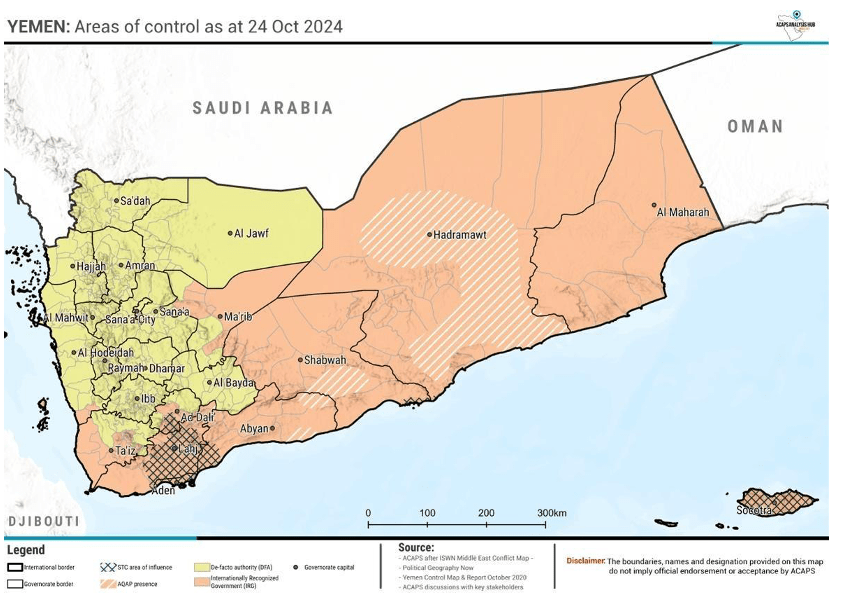
Figure 1: A map illustration to present the areas under IRG control, Houthi control (DFA), and AQAP influence (Al-Qaeda in the Arab Peninsula). Source`; ACAPS Analysis Hub. (2024) Yemen: Areas of Control, 24 Oct. 2024 [online]. [Accessed 30 Jan. 2025] Available at https://data.humdata.org/dataset/yemen-areas-of-control.
This paper aims to address the importance of a geographical perspective when analysing war tactics and the humanitarian impact war, using Yemen as an example. I will delve into the subdiscipline of political geography; key geographic scholars in the subdiscipline include Buhaug and Gates (2002), who discuss how fighting in civil wars is determined by geographical factors. Also, Le Bilon (2007), who researches geographical perspectives on resource wars; and Flint (2004) who refers to geographical ‘themes’ such as territoriality, borders and regionalisation theorising the causes and impact of war. In the context of Yemen’s conflict, Flint’s geographical theme of ‘regionalisation’ (how conflicts may ‘transcend political borders’, (Flint, 2004, 6)) may theorise how the Saudis and Iranians are fighting their war externally in the Yemeni state.
2. Methodology
This article is based on a review of existing literature on Yemen’s crisis, geographical studies on war, and additional news articles. These resources allow for the exploration and analysis of theories such the weaponisation of resources, women and children; and delving into the subfield of ‘mental health geography’. I also draw from various documentary film clips: two from Vice News, where documentary senior correspondent Isobel Yeung travels to neighbourhoods around Yemen, interviewing civilians; and another from the BBC filmed in the front-line neighbourhood of Taiz.
Using secondary resources poses limitations to research. Yet, the violence in Yemen has undermined capacities for monitoring and conducting research, placing constraints on primary data collection. Additionally western media biases can present misleading perspectives such as criticising state authority and legitimacy. Conclusions can be drawn from this secondary research; more broadly the idea that the conflict has dire humanitarian impacts, and that people and resources are weaponised.
3. Malnutrition epidemic: Food insecurity
Currently, 17.3 million Yemenis suffer from high levels of acute food insecurity. Six million are on the brink of famine (USA for UNHCR, 2024). This section explores the weaponisation of resources and delves into a case study scenario to explore the impact of such war tactics at the human, personal level.
Since 2015, the Saudi-led coalition has maintained a blockade, preventing Iran from providing weapons and ammunition to the Houthi rebels. They have forced Sana’a’s international airport to remain closed since 2016 and implemented the Hodeida blockade. The Houthi rebels have also attempted to enforce blockades by launching missiles towards Saudi Arabia and closing the main road into Taiz (Human Rights Watch, 2022).
As a result of the Hodeida blockade, a limited number of aid ships have been able to unload, leading to a desperate shortage of supplies such as food, water, and medicine. These shortages have put many individuals at risk of malnutrition (see section 3.2) and has increased the incidence of waterborne disease due to a lack of drinkable water (Borger, 2015). Sarkar (2022) argues that the blockade and military air attacks by the Saudi-led coalition are a war tactic that aims to control the food that reaches the citizens. This weaponisation of food through blockades is not a new phenomenon in historical or modern wars. In recent times, similar tactics have been used in December 2022 when Azerbaijan launched its blockade of the breakaway republic of Artsakh. Equally, the blockade of humanitarian resources is a common tactic of the Israeli Defence Force in Palestine.
Isobel Yeung—a senior correspondent for Vice News—interviews Mariam, a mother, who lives in an internally displaced persons (IDP) camp in the north of Yemen, in the town of Hajjah (Yeung, 2021). She is attending a makeshift clinic at the camp to treat her four-year-old son, who is acutely malnourished. Yeung enquires why her son’s hands are “red raw”, and Mariam replies, “he gnaws on it until it bleeds, he eats it out of hunger, I see blood on his teeth and mouth”. 49% of children under the age of five suffer from stunting or chronic malnutrition in Yemen (UNICEF, 2024). With the average food prices now 150% higher than before the conflict, 67% of Yemenis cannot reliably access or afford enough food (Imperial War Museums, n.d.). Analysing these figures geographically, further unemployment due to the economic collapse, inability of the Central Bank of Yemen to pay workers’ salaries (Evans, 2018) and the enforced mahram requirement for women (a requirement established centuries ago deriving from the word ‘haraam’ restricting women from travelling freely in Yemen without a male guardian, (or without his written approval) (Georgetown institute For Women, Peace and Security, 2022)) has led to civilians unable to receive their usual salaries (or have no salary at all), so they can certainly not afford this increase in food prices. Consequentially, more individuals have become reliant on humanitarian aid. With insufficient fuel imports and the closure of Ras Isa Port (Evans, 2018), there has been a restriction of aid arriving to humanitarian aid pick up locations, as a result, proliferating Yemen’s food insecurity.
4. Violation of Human Rights
The conflict in Yemen has engendered countless violations of international human rights laws, including issues regarding gender-based discrimination, denial of humanitarian access, child soldier recruitment, enforced killings, abuse against migrants, and more. This section explores the Houthi’s weaponisation of civilians—using people as tools to enforce rule and order in its captured territory.
Gender-based discrimination is certainly prevalent in Yemen. The country ranks last in both the Gender Gap Index and the Gender Inequality Index, which are measures of ‘inequality between women and men in three dimensions: reproductive health, empowerment and the labour market’ (World Health Organisation, n.d.) and ‘gender gaps on economic, political, education, and health-based criteria’ (Dyvik, 2024). Houthi restrictions increasingly hinder Yemeni women: there are discrepancies in ‘various domains including education, livelihood opportunities, protection, and political representation’ (Relief Web (OCHA), n.d.)—the Houthi verbally enforced ‘Mahram requirement’ described above is an example. This requirement is not part of Yemeni national law and is a Houthi enforced law. This has consequentially hindered women from travelling to their place of work, including Yemeni female humanitarian workers who must travel to conduct their fieldwork (Amnesty International, 2022). In 2022, Houthi authorities forced Yemeni women to close their businesses, banned the mixing of genders in public venues, and ‘mobilized all-female police units called zeinabiyat to suppress, abuse, and arrest women who reject Houthi ideology’ (Miller, 2023). The economic deterioration, political turmoil, and institutional collapse as a result of the civil war have led to a decline in the provision of women’s rights (ACAPS, 2023). The erosion of women’s freedom through the Houthi’s legislative mahram pressures could be an attempt to subvert the national Yemeni laws and assert Houthi control and order. Like other political Islamic movements, the Houthis use Islamic discourse to justify their right to power and legitimacy to rule (Al-Dawsari, 2017). Viewing the weaponisation of women geographically certainly addresses how the Houthis exploit identity as a war tactic.
In addition to Houthi restrictions, young girls have long been regarded as “financial burdens” to their families. However, due to the war, there is now a need to see them as “commercial commodities” (Yeung, 2021). Yeung interviews Iman, a young girl, 12 years of age, married off by her father five years ago for financial gain due to the poverty inflicted on the family due to the war. Iman was sold for just 240 US dollars. She states, “I didn’t want to get married; a person needs to be older to get married […] I want to go to school”. Yemen is home to four million child brides, with 32% of girls in Yemen married before their eighteenth birthday (Child’s Not Brides, n.d.). Viewing this geographically through a study published in 2021 in the Journal of Refugee Studies, displacement due to the conflict has influenced economic security and household power dynamics which affects marriage decision-making and a girl’s ability to self-advocate (Hunersen et al., 2021). This—alongside pre-existing cultural norms favouring early marriage, widespread poverty, and lack of education—has consequentially increased the incidence of child marriage in Yemen (EDCHR, 2024). Childhood marriage has ruinous impacts on young girls who are forced into adulthood before they are mentally and physically developed or able (Save the Children, n.d.).
The rights of children are also in question, since 2015, over 10,000 children have been recruited by Houthi forces to fight in the civil war (The New Arab Staff, 2021). Over 2000 of these children have been killed (Al Jazeera, 2022). The Houthis recruit children through a ‘summer camp’ system where the children are told they are joining a ‘holy war against Jews, Christians, and Arabs that have succumbed to Western influence’ (Al Jazeera, 2022). Children are engaging in warfare in several ways: ‘fighting, spying, laying mines, and working at security checkpoints’ (Nasser, 2023). The secondary impacts of the war (the absence of education and current economic and financial situation of civilians) primarily have paved the way for Houthis to recruit children in its forces without punishment. This ideology is evident in Sheikh’s (2022) geographical study, discussing the idea that the Houthis have exploited the economic and social conditions of civilians (for instance the death of a breadwinner) to recruit children, this exploitation is an ‘ideological’ project that is ‘achieving political gains’ (Sheikh, 2022). The phenomenon of child soldiers is referred to in O’Loughlin’s paper, he explains that in civil conflicts, the average age of the fighters is falling; ‘children as young as eight years of age are impressed into armies’ (O’Loughlin, 2004, 90). In Yemen, the recruitment of children is a key exploitative and psychological issue.
5. Psychological impacts: Yemen’s mental health crisis
An estimated 19.5% of the Yemeni population suffers from a mental disorder (Alhariri et al., 2021). 55% of Yemeni children are depressed and 79% of school-aged children in Sanaa display symptoms of post-traumatic stress disorder (Alhariri et al., 2021). When analysing the conflict in Yemen, it’s vital to address the psychological impact on the population; the subfield of ‘mental health geography’ (Philo, 2014) is useful here. Mental health geography discusses the spatial and place-related implications of both the experience of mental health and the provision of treatment facilities (Philo, 2014). This section will draw on case studies from psychiatric hospitals and present how civilians are subjected to ‘civilian victimisation’ (Downes, 2008) through the targeting of residential neighbourhoods on the front line in Taiz.
Yeung in her research visits one of the four psychiatric hospitals in Yemen where individuals walk around the premises in chains, often doped with tranquillisers (VICE News, 2021). In the interview, the director of the facility explains that he is chaining them up for their benefit: “It’s inhumane but a must; if I leave him outside, he will kill his sisters”. Due to the geographical sparseness of mental health support in the country, Yemenis often must travel some distance to reach facilities, which the majority are too poor to do. For instance, one rural family cannot access treatment facilities, they have resorted to chaining their 35-year-old son in a single room; the mother describes “we had to chain him up; there is no other way to deal with him. He beat me once in the head. He would go upstairs and throw stones” (VICE News, 2021). Yemen’s ‘mental health geography’ is in a particularly dire state. Not only is mental health support difficult to find and too expensive to travel to receive, but it is also burdened by a cultural stigma that complicates people’s willingness to access it. The Yemeni government has additionally been accused of ignoring its legal responsibility to fulfil the right to mental health (Alhariri et al., 2021), complicating this further.
The Frontline Neighbourhood of Al-Rasheed in Taiz contains the most vulnerable individuals who are exposed to severe risks from regular air strikes and shelling. A documentary correspondent from BBC News (Guerin, 2023) interviews Bader, age seven, who was hit by shrapnel on his return home from school. Bader wishes to be a doctor; however, he must return to school to be able to do so: “I want to go back, but my leg has been cut off”. On the same day, Amir, age three (Figure 2) was also wounded. His father explains that Amir has deep wounds of memory. He asks his son what he wants to do in the future, his response: “buy me a gun, I will put a bullet in my gun, and fire at those who took my leg”.
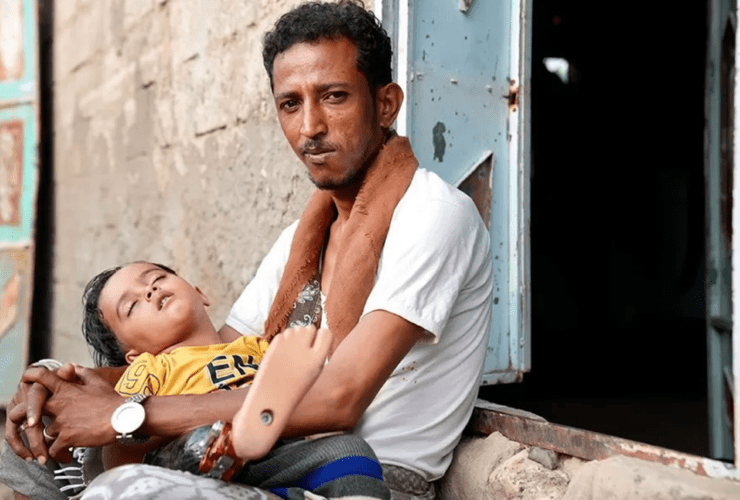
Figure 2. Image of Amir and his Father, Source Koraltan, G. 2023. Yemen: The children of a forgotten war [Online]. [Accessed 18 August 2024]. Available from: https://www.bbc.co.uk/news/world-middle-east-66258171.
At the end of 2021, the UN estimated that 377,000 people have been killed directly/indirectly by the war in Yemen (CAAT, 2023). The approximate direct death toll of 15,000 civilians (CAAT, 2023) includes those killed by the Saudi-led coalition in similar attacks to Bader and Amir in residential areas. The coalition has claimed that these airstrikes in residential areas target military facilities belonging to the Houthi rebels. However, local reports claim there were no military facilities in these locations. Oxfam have additionally ‘accused the coalition of deliberately attacking hospitals and water wells to worsen the humanitarian suffering’ (The Cradle, 2022). Downes (2008) analyses the idea of ‘civilian victimisation’, a coercive mechanism used to undermine an adversary’s military capability to socially resist. Two factors are primarily responsible for this civilian victimisation: one factor is that states tend to prize victory and preserving the lives of their own people above humanity in warfare, two is that it is used as a coercive strategy to persuade an enemy’s government to accede to the coercers political or military demands (Downes, 2008, 4). Civilian cooperation is vital in Houthi war tactics, for instance, forming troops and acting as human shields. O’Loughlin’s (2004) geographical concept of ‘democide’ (destruction of the people) is certainly applicable to this civilian victimisation; it must be noted that governments ‘kill many more of their citizens than rebels…more than four times more people are killed by their governments than in wars’ (O’Loughlin, 2004, 90).
6. Conclusions
Taking a geographical approach to analyse Yemen’s conflict allows one to appreciate the complexity of the crisis, considering Yemen’s geographic location, cultural norms, economic issues, political and historic past, and religious division. Economic collapse still threatens daily life, children remain out of education, further funding cuts exacerbate the humanitarian suffering and half of Yemen still faces severe hunger. This paper has stressed the importance of a geographical perspective when analysing the Yemeni conflict. Using geographical literature, studies and case study examples, certain war tactics and less familiar impacts are brought to light, for instance, the mahram requirement limitations and psychological impacts of the crisis.
Looking towards Yemen’s future, at the time of writing in January 2025, the April 2022 six-month ceasefire between the Saudi-led coalition and the Houthi rebels has not been renewed. There has not been a full-scale return to the domestic fighting however, the Houthi rebels have directed their efforts towards the Israel-Hamas conflict, most notably launching missiles and drones on ships in the Red Sea. The Houthi’s have attacked nearly 190 ships between November 2023 and October 2024 (Blanchard, 2024), impacting over 65 different countries and 29 major shipping companies (Defence Intelligence Agency USA, 2024). Israel, the US, and the UK have responded with strikes against the Houthi’s, both in the Red Sea and in Yemen itself. One may question the motives for the participation of the Houthi’s in the Israel-Hamas conflict. Essentially, the Houthi’s have opposed the Israelis since the rebel group’s creation with their slogan comprising of “God is great, death to America, death to Israel, a curse upon the Jews, victory to Islam” (Junyent, 2023). These attacks could be an attempt to bring the Houthi’s closer to their allies in the ‘Axis of Resistance’ (‘a network of militant Islamist groups through which Iran can project power’ consisting of Hamas, Hezbollah and pro-Iranian militias in Iraq (Burke, 2024)). The Houthis have received political and military support from Iran for their domestic fight in Yemen; however, in comparison to the other members of the axis (Hezbollah), the support has been limited (Junyent, 2023). I deduce that the Houthi participation is an attempt to strengthen the ties between Iran and the other axis members to gain further support for their domestic fight in Yemen.
Returning to the Yemen conflict, according to Elisabeth Kendall, a Yemen expert at the University of Cambridge interviewed by Al-Jazeera, “Saudi is now keen to exit the war, but for the Houthis, war has become a way of life” (Cafiero, 2023). The Houthis are unlikely to come to a peace agreement without extracting major concessions in the form of power, territory, and resources. The agreement would permanently end Saudi-led airstrikes but would not end the conflict. Peace in Yemen is a far-fetched reality: Kendall (2023) states “there are many militias invested in the Yemen war beyond just Saudi Arabia and the Houthis, whose aims and ambitions would all need to be addressed” (Cafiero, 2023). Yemen’s future remains dubious, there is a need for further research into the human rights of civilians, to ensure they are protected from the various impacts discussed in this essay.
Acknowledgements
Lynda and James Lyne.
References
ACAPS (2023) Dynamics and effects of the Mahram practice in Yemen. [online] Available at: https://www.acaps.org/fileadmin/Data_Product/Main_media/20231214_ACAPS_Yemen_Analysis_Hub_Dynamics_and_effects_of_the_Mahram_practice_in_Yemen_01.pdf. [Accessed 18 Aug. 2024]
ACAPS Analysis Hub. (2024) Yemen: Areas of Control – 24 Oct. 2024 [online]. Available at https://data.humdata.org/dataset/yemen-areas-of-control?
[Accessed 30 Jan. 2024]
Abdulaziz, K. (2023). Why the Houthis Attacked Israel [online] Available at: https://gulfif.org/why-the-houthis-attacked-israel/ [Accessed 7 Feb. 2025]
Alhariri, W., Mcnally, A. and Knuckey, S. (2021). The Right to Mental Health in Yemen. Health and Human Rights, [online] 23(1), pp.43–53. Available at: https://www.ncbi.nlm.nih.gov/pmc/articles/PMC8233030/#:~:text=In%20Yemen%2C%20where%20the%20average.
Al-Dawsari, N. (2017). The Houthis’ endgame in Yemen. [online] Al Jazeera. Available at: https://www.aljazeera.com/opinions/2017/12/21/the-houthis-endgame-in-yemen.
Al Jazeera (2022). Houthis continue to recruit child soldiers, despite Yemen truce. [online] Available at: https://www.aljazeera.com/news/2022/6/16/houthis-continue-to-recruit-child-soldiers-despite-yemen-truce. [Accessed 18 Aug. 2024].
Amnesty International. (2022). Yemen: Huthis ‘suffocating’ women with requirement for male guardians. [online] Available at: https://www.amnesty.org/en/latest/news/2022/09/yemen-huthis-suffocating-women-with-requirement-for-male-guardians/ [Accessed 18 Aug. 2024]
BBC (2021). Yemen crisis: Why is there a war? BBC News. [online] 2 Nov. Available at: https://www.bbc.co.uk/news/world-middle-east-29319423.
BBC (2015). Yemen: Aden ‘liberated’ from rebels, exiled leader says. [online] BBC News. Available at: https://www.bbc.co.uk/news/world-middle-east-33563190 [Accessed 18 Aug. 2024].
Blanchard, C. (2024). Yemen: Conflict, Red Sea Attacks, and U.S Policy [online] Available at: https://crsreports.congress.gov/product/pdf/IF/IF12581 [Accessed 7 Feb. 2025].
Borger, J. (2015). Saudi-led naval blockade leaves 20m Yemenis facing humanitarian disaster. [online] the Guardian. Available at: https://www.theguardian.com/world/2015/jun/05/saudi-led-naval-blockade-worsens-yemen-humanitarian-disaster. [Accessed 18 Aug. 2024]
Bunyan, M. (2019). Islam and Politics in Contemporary Asia and the Middle East — Asia Institute. [online] Faculty of Arts. Available at: https://arts.unimelb.edu.au/asia-institute/our-research/islam-politics. [Accessed 18 Aug. 2024].
Buhaug, H., & Gates, S. (2002). The Geography of Civil War. Journal of Peace Research, 39(4), 417-433. Available at: https://doi.org/10.1177/0022343302039004003 [Accessed 4 Nov. 2024].
Burke, J. (2024). Iran’s ‘axis of resistance’ is a potent coalition but a risky strategy. [online]
Available at: https://www.theguardian.com/world/2024/jan/14/irans-axis-of-resistance-is-a-potent-coalition-but-a-risky-strategy [Accessed 7 Feb. 2025].
Cafiero, G. (2023). Analysis: Fighting recedes, but Peace in Yemen Remains Distant. [online] http://www.aljazeera.com. Available at: https://www.aljazeera.com/news/2023/7/7/analysis-peace-yemen-remains-distant
Campaign Against Arms Trade. (2022). The war on Yemen’s civilians. [online] Available at: https://caat.org.uk/homepage/stop-arming-saudi-arabia/the-war-on-yemens-civilians/ [Accessed 18 Aug. 2024].
Center for Preventive Action (2024). War in Yemen. [online] Global Conflict Tracker. Available at: https://www.cfr.org/global-conflict-tracker/conflict/war-yemen.
Conley et al (2022). ‘Once We Control Them, We Will Feed Them’, Sarkar, A. Accountability for Mass Starvation: Testing the Limits of the Law. Oxford; online edn, Oxford Academic. Pages 217–259.
Definition of ‘Houthi’. (n.d.). In: Collins English Dictionary. [online] Glasgow: HarperCollins. Available at: https://www.collinsdictionary.com/dictionary/english/houthi [Accessed 18 Aug. 2024].
Defence Intelligence Agency USA (2024). Yemen: Houthi Attacks Placing Pressure on International Trade [online] Available at: https://www.dia.mil/Portals/110/Images/News/Military_Powers_Publications/YEM_Houthi-Attacks-Pressuring-International-Trade.pdf [Accessed 7 Feb. 2025]
Downes, A. (2008). Targeting Civilians in War. 1st edn New York: Cornell University Press.
Dyvik, E (2024). The global gender gap index 2024 [online] Available at: https://www.statista.com/statistics/244387/the-global-gender-gap-index/#statisticContainer. [Accessed 21 Oct. 2024].
ECDHR (2024). Yemen’s Daughters: The Battle Against Child Marriage Amidst War [online] . Available at: https://www.ecdhr.org/yemens-daughters-the-battle-against-child-marriage-amidst-war/ [Accessed 18 Aug. 2024].
Evans, E (2018). Food Access and Conflict: Responsibility and Future Prosecution Guidelines for the Continued Humanitarian Violations of the Yemeni People, Middle Tennessee State University.
Fellman et al (2015) ‘Chapter 15 Conflict in Yemen: From Ethnic Fighting to Food Riots’, In Gros, A, Gard-Murray, A, Bar-Yam, Y, (eds) Conflict and Complexity, Countering Terrorism, Insurgency, Ethnic and Regional Violence, New York, Springer, Pages 269-277.
Flint, C (2004) ‘Introduction: Geography of War and Peace’: From The Geography of War and Peace, In Flint, C (eds) From Death Camps to Diplomats, New York, online edn, Oxford Academic, Pages 3 – 9.
Georgetown Institute For Women, Peace and Security (2022). Mahram: Women’s Mobility in Islam. [online] Available at: https://giwps.georgetown.edu/wp-content/uploads/2022/08/Mahram-Womens-Mobility-in-Islam.pdf [Accessed 22 Oct. 2024].
Girls Not Brides (n.d.). Child marriage atlas [online] Available at: https://www.girlsnotbrides.org/learning-resources/child-marriage-atlas/atlas/yemen/.
Guerin, O (2023). The children of Yemen’s forgotten war – BBC News. [online] YouTube. Available at: https://www.youtube.com/watch?v=ZocnjqtzuG0
and https://www.bbc.co.uk/news/world-middle-east-66258171. [Accessed 18 Aug. 2024].
Human Rights Watch. (2022). Yemen: Houthis Should Urgently Open Taizz Roads. [online] Available at: https://www.hrw.org/news/2022/08/29/yemen-houthis-should-urgently-open-taizz-roads. [Accessed 18 Aug. 2024]
Hunersen, K., Attal, B., Jeffery, A., Metzler, J., Alkibsi, T., Elnakib, S. and Robinson, W.C. (2021). Child marriage in Yemen: a mixed methods study in ongoing conflict and displacement. Journal of Refugee Studies, 34(4). Pages 4551–4571
Imperial War Museums. (n.d.). Yemen: Inside a Crisis – Food Security. [online] Available at: https://www.iwm.org.uk/history/yemen-inside-a-crisis-food-security#:~:text=In%202018%20the%20cost%20of [Accessed 18 Aug. 2024]
Junyent, M. (2023). Why Are the Houthis Getting Involved in a War Between Israel and Hamas? [online] Available at: https://www.stimson.org/2023/why-are-the-houthis-getting-involved-in-a-war-between-israel-and-hamas/ [Accessed 7 Feb. 2025]
Lackner, H. (2023) Yemen in Crisis: Devastating Conflict, Fragile Hope. 2nd edn. London: Saqi Books
Le Billon, P. (2007). Geographies of War: Perspectives on? Resource Wars? Geography Compass, 1(2), pp.163–182. Available at: https://doi.org/10.1111/j.1749-8198.2007.00010.x
[Accessed 4 Nov. 2024]
Marshall, T. (2016). Prisoners of geography: ten maps that tell you everything you need to know about global politics. 2nd edn. London: Elliott And Thompson Limited.
Miller, H. (2023). RELIGIOUS FREEDOM IN HOUTHI- CONTROLLED AREAS OF YEMEN UNITED STATES COMMISSION on INTERNATIONAL RELIGIOUS FREEDOM Religious Freedom in Houthi-Controlled Areas of Yemen. [online] Available at: https://www.uscirf.gov/sites/default/files/2023-05/2023%20Factsheet%20Houthi%20%281%29.pdf.
Nasser, A. (2023). Child Soldiers in Yemen: Cannon Fodder for an Unnecessary War. [online] Arab Center Washington DC. Available at: https://arabcenterdc.org/resource/child-soldiers-in-yemen-cannon-fodder-for-an-unnecessary-war/. [Accessed 18 Aug. 2024].
Office, D. (2013). Yemen travel advice. [online] GOV.UK. Available at: https://www.gov.uk/foreign-travel-advice/yemen#:~:text=FCDO%20advises%20against%20all%20travel%20to%20Yemen. [Accessed 18 Aug. 2024].
O’Loughlin, J. (2004). ‘The Political Geography of Conflict: Civil Wars in the Hegemonic Shadow’, in Colin Flint (ed.), The Geography of War and Peace: From Death Camps to Diplomats (NY, 2004; online edn, Oxford Academic), https://doi.org/10.1093/oso/9780195162080.003.0010 [Accessed 4 Nov. 2024].
Oxfam GB. (2023). After eight years of war, Yemen on the brink of economic collapse. [online] Available at: https://www.oxfam.org.uk/media/press-releases/after-eight-years-of-war-yemen-on-the-brink-of-economic-collapse-oxfam/ [Accessed 18 Aug. 2024].
Philo, C. (2014). Mental health geographies? In C. McGeachan (Ed.), Asylum and
post-asylum spaces. Available at: https://asylumspaces.wordpress.com/2014/09/04/mental-healthgeography
Relief Web (n.d.). Gender considerations in the Humanitarian Response in Yemen | ReliefWeb Response. [online] Available at: https://response.reliefweb.int/yemen/gender-considerations-humanitarian-response-yemen#:~:text=Yemen%20currently%20ranks%20last%20in. [Accessed 18 Aug. 2024]
Robinson, K. (2023). Yemen’s Tragedy: War, Stalemate, and Suffering. [online] Council on Foreign Relations. Available at: https://www.cfr.org/backgrounder/yemen-crisis. [Accessed 18 Aug. 2024]
Save the Children (n.d.). Child Marriage: A Violation of Child Rights. [online]. Available at: https://www.savethechildren.org/us/charity-stories/child-marriage-a-violation-of-child-rights#:~:text=Early%20marriage%20has%20devastating%20consequences. [Accessed 18 Aug. 2024].
Sheikh, E.Y.S., Alshageri, S. and Hamood, M.A.H.H. (2022). Factors influencing children armed recruitment in Yemen. Cogent Social Sciences, 8(1). Available at: https://doi.org/10.1080/23311886.2022.2108137
The Cradle (2022). Saudi-led coalition attacks residential areas in Yemen. [online] thecradle.co. Available at: https://thecradle.co/articles-id/5062 [Accessed 7 Nov. 2024].
The New Arab Staff (2021). Yemen’s Houthi rebels ‘recruited’ thousands of child soldiers. [online]. Available at: https://www.newarab.com/news/yemens-houthi-rebels-recruited-thousands-child-soldiers [Accessed 18 Aug. 2024].
The United Nations in Yemen. (n.d). The United Nations in Yemen. [online] Available at: https://yemen.un.org/en/about/about-the-un#:~:text=With%2024.1%20million%20people%20
[Accessed 18 Aug. 2024].
UNICEF (2024). 9 years into the conflict in Yemen, millions of children are malnourished and stunted. [online] Available at: https://www.unicef.org/press-releases/9-years-conflict-yemen-millions-children-are-malnourished-and-stunted#:~:text=The%20fragility%20is%20most%20clearly. [Accessed 18 Aug. 2024]
UNHCR (2022). Yemen Crisis Explained. [online]. Available at: https://www.unrefugees.org/news/yemen-crisis-explained/.%5BAccessed 18 Aug. 2024]
UNICEF (2022). Yemen: Acute hunger at unprecedented levels as funding dries up. [online] Available at: https://www.unicef.org/press-releases/yemen-acute-hunger-unprecedented-levels-funding-dries#:~:text=Yemen%20depends%20almost%20entirely%20on. [Accessed 18 Aug. 2024]
VICE News (2021). Yemen’s Mentally Ill Are Chained, Tranquilized & Abandoned. [online] Available at: https://www.youtube.com/watch?v=mOn3vBk1A-s. [Accessed 18 Aug. 2024].
VICE NEWS (2021). Children in Yemen Are So Hungry They’re Eating Their Own Hands. [online] Available at: https://www.youtube.com/watch?v=771PoYw8Lrk. [Accessed 18 Aug. 2024]
VICE NEWS (2021) the women fighting to protect Yemen: [online] available at https://www.youtube.com/watch?v=dbU37lo5fV4 [Accessed 18 Aug. 2024]
World Health Organization (n.d.). Gender Inequality Index (GII). [online] http://www.who.int. Available at: https://www.who.int/data/nutrition/nlis/info/gender-inequality-index-(gii). [Accessed 22. Oct 2024]
#Write for Routes
Are you 6th form or undergraduate geographer?
Do you have work that you are proud of and want to share?
Submit your work to our expert team of peer reviewers who will help you take it to the next level.
Related articles
 Routes